The planned actions may be carried out in classroom or online format
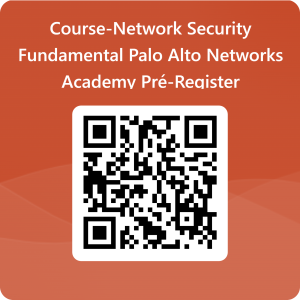
ESGT Faculty/Student To pré-register for the desired training course, please fill out the following form at the following address (or follow the next QRcode) with your ESGT Office 365 Account.
All Trainees will be notified before the session starts and after the applications are ranked
Network Security Fundamentals
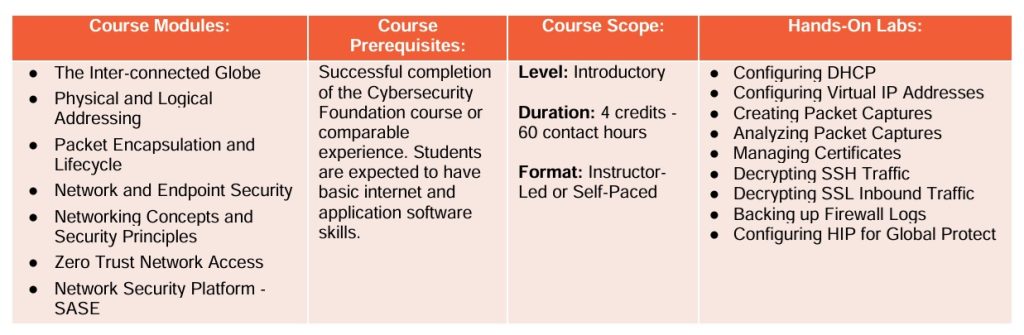
This course provides the student with an understanding of the fundamental tenets of network security and covers the general concepts involved in maintaining a secure network computing environment.
Upon successful completion of this course, students will be able to examine and describe general network security fundamentals as well as implement basic network security platform configuration techniques.
NIST/NICE Alignment and Work Roles:
Implementation and Operation – Technical Support (IO-WRL-007)
Implementation and Operation – Network Operations (IO-WRL-004)
Potential Job Roles:
- Technical Support Associate
- Help Desk Associate;
- Network Operations Specialist;
- Network Admin Associate;
- Cybersecurity Specialist
Course Objectives:
- Identify the most common enterprise network devices.
- Differentiate between routed and routing protocols.
- Recognize the various types of area networks and topologies.
- Describe the Domain Name System DNS, FQDN, and IoT.
- Recognize decimal, binary, and hexadecimal conversion methods.
- Describe the structure and fields of an IP header, IPv4, and IPv6 addresses.
- Submit IPv4 address schemes and configure an IP address on the network.
- Review DHCP processes and configure Network Address Translation (NAT).
- Configure the server as a DHCP server and test the DHCP client.
- Identify protocols and define the OSI and TCP model layers.
- Review the transport layer protocols, ports, and packet filtering procedures.
- Create and analyze packet captures using Wireshark.
- Configure the NGFW root certificate authority and key management concepts.
- Generate a Self-Signed Root Certificate Authority (CA) certificate.
- Create a decryption policy on the NGFW to decrypt SSL traffic and SSH traffic.
- Describe the benefits of the next generation firewall specific to the SSL generation.
- Identify the NGFW App-ID, User-ID, Content-ID and deployment options.
- Explore the five steps required to implement a NGFW zero-trust network.
- Configure the NGFW to monitor, forward, and backup system logs.
- Define SASE and describe SASE features and functions.
- Understand the concepts and values of Software-Defined WAN – SDWAN.